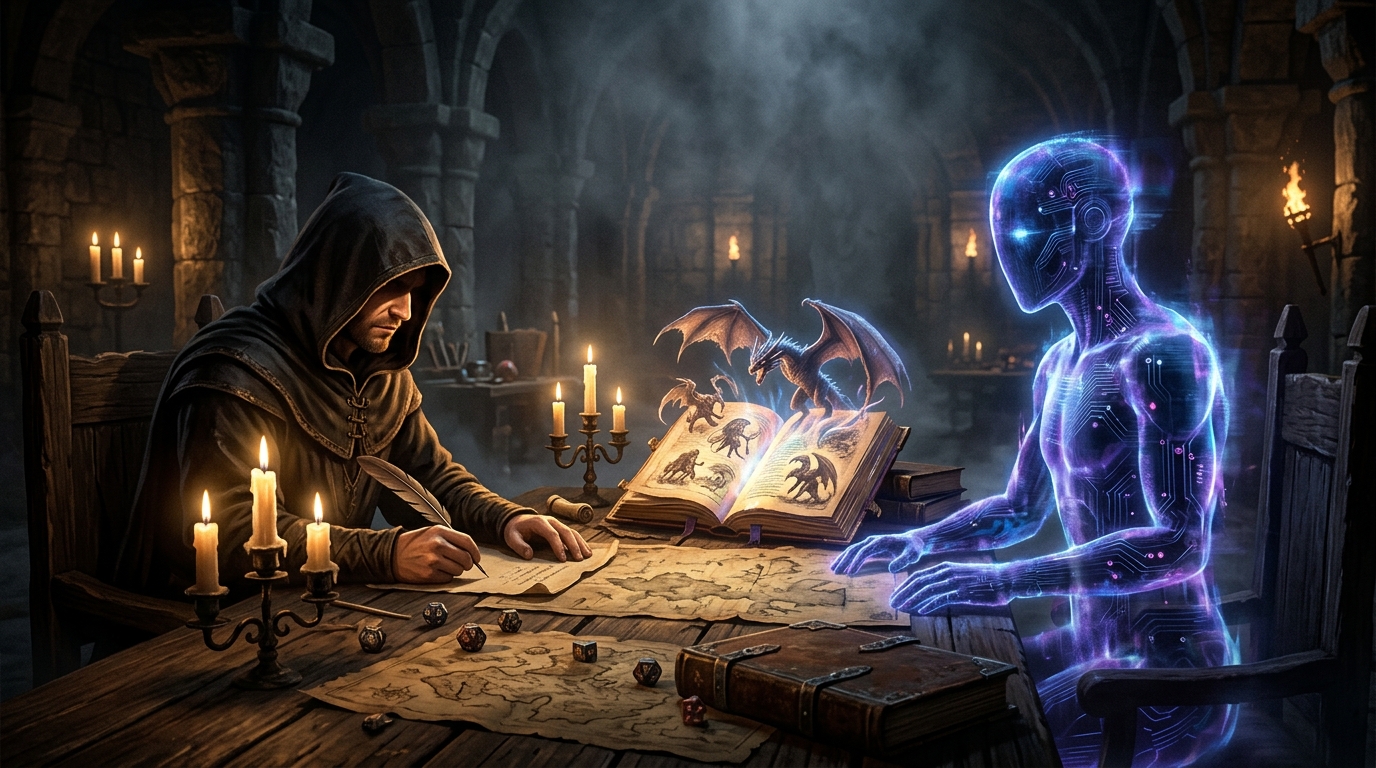
Five years ago, the phrase "AI dungeon master" sounded like marketing fantasy. Today, platforms like AI Quest and AI Dungeon guide millions of players through dungeons, taverns, and cursed ruins — no scheduling required, no group of friends needed around a table. AI-powered text RPGs promise something a human GM physically cannot deliver: an infinite world ready to respond to your wildest ideas at three in the morning. But can artificial intelligence actually tell a story — with meaning, tension, and the weight of real choices — or is it merely a clever simulation of narrative, leaving humans with the monopoly on genuine storytelling?
What Is an AI Storyteller and How Does It Work in Text RPGs?
An AI storyteller is a language model playing the role of game master in a text-based session. Where once you needed a human Dungeon Master with a folder full of notes and a bag of dice, a neural network now handles everything: describing locations, voicing NPCs, rolling virtual dice, and reacting to every player decision in real time. At its core, an AI-driven tabletop RPG is a dialogue — one side inventing the world on the fly, drawing on a prompt, system instructions, and the ongoing conversation history.
Under the hood of a modern AI game master, you'll typically find large language models — GPT-4, Claude 3.5, Gemini, or open-source alternatives like Llama and Mistral. Specialized engines layer on top of these: AI Dungeon with its proprietary models, NovelAI, KoboldAI, and niche dark-fantasy platforms like AI Quest, where the model is fine-tuned for grim narrative and genre-specific tropes. These engines add what the base model lacks: character memory, stat systems, inventory, skill checks, and story triggers.
The key mechanism is the context window — the volume of text the model holds in active memory at any moment, typically ranging from 8,000 to 200,000 tokens. Inside this window live the world description, your character sheet, recent scenes, and key NPCs. As the story grows, the engine compresses older events into brief summaries to preserve cause-and-effect continuity — otherwise, twenty turns in, your loyal companion might forget they're dead.
Narrative generation works predictively: the model constructs the most probable continuation of the text given the style and context. When you type "I draw my sword and attack the cultist," the AI storyteller doesn't select from a pre-written scene tree — it composes a description of the strike, the enemy's reaction, and the consequences right then and there. That's precisely why AI text RPGs feel alive: every playthrough is unique, and the world bends to the player rather than the other way around.
The Human GM's Strengths: What AI Still Can't Do
When people compare AI vs human GM, it's easy to get fixated on technical metrics: memory capacity, generation speed, world size. But a human game master is playing a different game entirely — they read the room. They notice a player wince at the mention of spiders, catch the fighter who's been silently rolling a die for thirty minutes, and wordlessly reshape the scene. That feedback loop of facial expressions, pauses, and tone of voice lies beyond the reach of even the most advanced AI dungeon master.
An experienced D&D GM who has run the same group for years remembers that the cleric's player lost their brother three campaigns ago — so when an NPC priest appears with a similar name, it lands as an emotional gut punch nobody saw coming. In a mechanics-heavy system like Pathfinder, a skilled GM can balance an encounter on the fly: if the fighter crits twice in a row, the monster suddenly "remembers" a resistance; if the wizard fails three saving throws, the enemy conveniently "runs out" of spell charges.
Long-term planning is another human stronghold. A great GM plants hooks in session one that pay off six months of real time later. They hold entire character arcs, faction intrigues, and buried secrets in their head, weaving them toward a finale with surgical precision. An AI storyteller in a text RPG runs reactively — responding to player actions rather than spinning a web thirty sessions in advance.
The social layer matters just as much. A tabletop game is pizza on the table, jokes between dice rolls, rules arguments, shared laughter when the rogue fails a stealth check by one. The human GM conducts not just the narrative but the energy of the whole group. No AI role-playing system replaces the ritual of four friends hunched over a dungeon map — and perhaps it shouldn't try.
The AI GM's Advantages: Availability, Speed, and an Infinite World
The AI storyteller's biggest trump card is simple and brutal: it's always there. Three in the morning on a Tuesday, a solo vacation abroad — the AI dungeon master opens the dungeon door the moment you click the button. No scheduling negotiations across a seven-person group chat, no sessions cancelled because the GM has a cold, no months of hunting for a group on forums. Solo play stops being a compromise and becomes a fully legitimate way to live out stories.
An AI storyteller in a text RPG doesn't tire after hour four, doesn't lose its voice, doesn't lose focus because a child woke up in the next room. It maintains pace for exactly as long as you can. Want a weekend marathon with a single character? Done. Want fifteen minutes before bed to advance the plot by one scene? That works too.
Narrative speed is its own story. In a live session, describing a new location takes three to five minutes — the GM rifles through notes, improvises, fields clarifying questions. An AI delivers a detailed scene in seconds and immediately picks up whatever you do next. Decided to climb the drainpipe instead of using the door, set the rug on fire, or negotiate with a corpse? The response is instant, no frustrated sigh of "that wasn't in my plan."
An infinite world isn't marketing hype. Generative models create:
- unique dungeons with unpredictable layouts on every run;
- hundreds of NPCs with distinct speech patterns and motivations;
- side quests that never appeared in any published module;
- consequences for your wildest decisions, not pre-scripted branching paths.
Add to that the absence of human bias — the AI doesn't hold a grudge from last session, doesn't favor the group's golden child, doesn't punish creativity that falls outside its personal taste. It's a pure narrative engine, and there's an honest integrity to that neutrality.
Story Quality: Narrative Coherence, Consistency, and Character Depth
If the AI vs human GM debate comes down to one question, it's this: whose story holds together over ten consecutive sessions without sagging? Both sides have their demons.
The AI storyteller's weak points are memory drift and hallucinations. By the twentieth turn, the AI might forget you killed the baron back in chapter one and have him send you an angry letter. Your companion's name shifts imperceptibly from Kiran to Kieran, the tavern called the Broken Blade becomes the Rusty Blade, and the magic system the AI invented an hour ago contradicts itself by the next scene. Modern platforms fight this with vector knowledge bases and scene summaries, but the seams still show occasionally.
The second problem is formulaic storytelling. Large language models are trained on thousands of fantasy texts, and without strong directional prompts the AI gravitates toward familiar rails: the mysterious stranger in a cloak, the ancient prophecy, the traitor in the party revealed in act three. A twist that would hit like a sucker punch from a human GM reads like a page from the genre handbook when an AI delivers it.
But the human GM is no gold standard either. Five hours deep in a friend's basement, descriptions grow shorter, NPCs start sounding identical, and the GM muddles names just as badly as any algorithm. A prepared plot unravels when the party does something unpredictable, and the GM falls back on "a thick fog rolls in and guards appear" — because the brain has nothing left. Creative reserves are finite, and next Friday there's another session to run.
On character depth, the human still has the edge — for now. A human DM remembers that your paladin's father betrayed them in childhood and arranges a reunion ten sessions later at the most painful possible moment. An AI storyteller in a text RPG can do something similar if you maintain careful character notes, but emotional timing remains a weak spot.
Narrative verdict: the human wins on dramatic structure and emotional arcs; the AI wins on tonal consistency, descriptive density, and the willingness to write at three in the morning without any dip in quality.
Dark Fantasy and AI: How Platforms Like AI Quest Are Reshaping the Genre
Dark fantasy spent decades living in the shadow of more mainstream heroic epics. Bloody cults, moral ambiguity, a world where every victory is paid for in someone's death — for a traditional tabletop campaign, that kind of setting demands a GM with nerves of steel and literary sensibility. Finding that person is hard. Which is why specialized AI narrative platforms are reshaping the genre faster than the publishing industry ever could.
AI Quest is a prime example of how AI for role-playing games gets sharpened for a specific aesthetic. A base language model can write elves and dragons, but it doesn't feel the difference between Tolkien and Abercrombie. To build a genuine AI storyteller for dark fantasy text RPGs, developers layer in system instructions: no "Disney ending" resolutions, a real price for every major choice, descriptions that grab visceral details — the smell of char, the snap of a tendon, the cold of a stone altar.
An AI game master excels in dark worlds for two specific reasons. First, it won't flinch when a player proposes burning a village to the ground or betraying their mentor. A human GM often softens consequences out of empathy; the model follows the brutal world's logic to its conclusion. Second, atmosphere generation. Describing a rotting forest or a heretic's interrogation in three dense paragraphs is a task where a language model frequently outperforms a GM exhausted after a full workday.
Custom prompts elevate this to a genuine craft tool. The player sets the tone — "low fantasy, no healing magic, the Inquisition is active" — and the AI dungeon master reshapes the world within those constraints. The AI text RPG becomes a personal serialized story where genre integrity depends not on luck with your gaming group, but on how you configure the model.
The Hybrid Approach: AI as a Tool for the Human GM
The "AI vs human GM" debate loses its point the moment a GM at the table opens a laptop and gets a goblin innkeeper's name — a whispering fence of stolen relics — in ten seconds flat. The human GM stays the director of the story; the AI for role-playing becomes their prep department, research library, and creative workshop all at once.
Specific scenarios where the partnership beats any rivalry:
- On-the-fly NPC generation. Players ducked into an alley that isn't in your notes? ChatGPT delivers a potion merchant with a dark past, three secrets, and a distinctive speech pattern in under a minute.
- Random loot and encounter tables. The AI generates d100 tables tailored to a specific campaign region — the marshes of Lirgon sound nothing like the catacombs beneath Old Cane.
- Location descriptions. A dry note reading "abandoned temple" becomes three paragraphs of atmospheric prose complete with smells, sounds, and investigation hooks.
- Filling inter-session gaps. What was the secondary antagonist doing while the party rested at the inn? The AI works out their moves and plants evidence for the next encounter.
The toolkit comes together quickly: ChatGPT or Claude for scene and dialogue prep, Midjourney and Stable Diffusion for NPC portraits and maps, dedicated GM apps like LegendKeeper or Friends & Fables for campaign knowledge management. Platforms built for AI text RPGs like AI Quest serve as sandboxes where GMs stress-test story branches before running them live.
In practice, the "AI dungeon master or human" dilemma resolves itself simply — the AI game master handles the grind, and the GM invests the freed-up energy into what players actually come for: improvisation, emotion, and the shared table.
Verdict: Who Tells the Better Story in 2025?
The honest answer is neither — or rather, both, in different weight classes. The human GM still holds the crown where delicate emotional direction is needed: the finale of a two-year campaign, the betrayal of an NPC the whole party has fallen for, the moment a player tears up over their paladin's death. A human feels the room, catches the tremor in a voice, knows when to let ten seconds of silence do the work. An AI game master can't do that yet — it plays out the scene, but it doesn't conduct the room.
Everywhere else, AI is closing the gap fast — and in some areas has already pulled ahead. An AI text RPG is available at three in the morning, doesn't cancel because one player has the flu, requires no twenty-page prep document, and never hits a wall because the GM is burned out after a long work week. An infinite world, instant adaptation, zero social friction for introverts — these aren't small bonuses, they're an entirely different leisure format.
The near-term trajectory is clear: models will learn to remember campaigns across hundreds of hours, track character arcs, generate NPC voices in real time, and adjust narrative pacing to the player's emotional state. The line between AI storyteller and human GM will keep blurring — from the AI's side.
If you haven't tried it yet — step into AI Quest and spend one evening in a dark fantasy world where the storyteller bends to your every decision. Compare for yourself. That's the only way to know which story is really yours — at a table with friends, alone with an AI, or somewhere in between.
FAQ: Common Questions About AI Game Masters in RPGs
Can AI fully replace a human game master?
In 2025 — no, and not in the foreseeable future either. An AI game master handles descriptions, location generation, NPC creation, and real-time reactions to player actions with impressive skill, but a human still reads the dramatic arc of a long campaign better, remembers emotional character threads across dozens of sessions, and knows when to break their own rules for the sake of a beautiful moment. That said, an AI role-playing system is available at three in the morning and never cancels because of a cold — which is why many players run both formats in parallel.
Which AI text RPG platforms are best for beginners?
If you're new to the genre, start with platforms that don't require learning a rulebook or rolling dice manually. AI Quest, AI Dungeon, and NovelAI all operate on the same principle: write what your character does, receive the story's continuation. AI Quest is especially suited to players who love a grim atmosphere — dark fantasy, gothic horror, survival in cursed lands. For a classic D&D feel with structured combat and character stats, more mechanics-forward services like Friends & Fables are worth a look.
How does AI handle unexpected player actions?
This is the AI storyteller's greatest strength. An AI text RPG has no pre-written script — every decision you make is processed on the fly. Want to seduce the dragon, rob the temple, or declare yourself a god? The AI dungeon master runs with the idea and unfolds the consequences. Limitations emerge over long distances: the AI may forget a detail from chapter fifty and contradict it in chapter one hundred. Good platforms address this through persistent memory systems and world-state notes.
Is it safe to play dark fantasy with an AI storyteller?
Technically, yes — emotionally, it depends on you. An AI text RPG storyteller describes violence, moral dilemmas, horror, and betrayal without judgment, which is exactly what draws fans to the genre. Platforms like AI Quest let you tune the content's darkness level. If you're sensitive to specific themes, set those boundaries in your opening prompt — the AI will honor them. From a data perspective, only play on platforms with a clear, transparent privacy policy.
How much do AI game master platforms cost?
Most services run on a freemium model: basic play is free, with extended models and long-term memory available via subscription ranging from roughly $5 to $30 per month. AI Quest offers an introductory free tier — more than enough to find out whether AI role-playing is for you. When comparing AI vs human GM on price: a single session with a professional DM on platforms like StartPlaying typically costs more than a full month's subscription to any AI service.
Comments